Why Red Light Therapy Uses Two Different Wavelengths
This is one of those questions that tends to come from the more curious clients, usually somewhere around their third or fourth session.
They’ve started feeling the benefit, they’ve noticed the panels glow one colour but feel like they’re doing something deeper too, and they want to know what’s actually going on. Fair question, and it deserves a proper answer rather than “it’s just how the machine works.”
This completes a theme I’ve been building across a few articles now, looking past the general benefits of our therapies and into the actual mechanisms underneath them.
We’ve covered why hyperbaric oxygen works the way it does, and how compression therapy moves blood without help from your heart.
This one is about light, and why red light therapy at BE SUPERHUMAN always uses two wavelengths together rather than just one.
Light Isn’t One Thing
The first thing worth clearing up is that “red light” isn’t a single, uniform type of light. Visible light sits across a spectrum, and different points on that spectrum behave differently once they hit skin.
Two points on that spectrum matter for this treatment specifically : red light, sitting around 660 nanometres, and near-infrared light, sitting around 850 nanometres.
Nanometres just describe the wavelength, essentially how long each light wave is from peak to peak. It’s a small difference in number but a meaningful difference in behaviour.
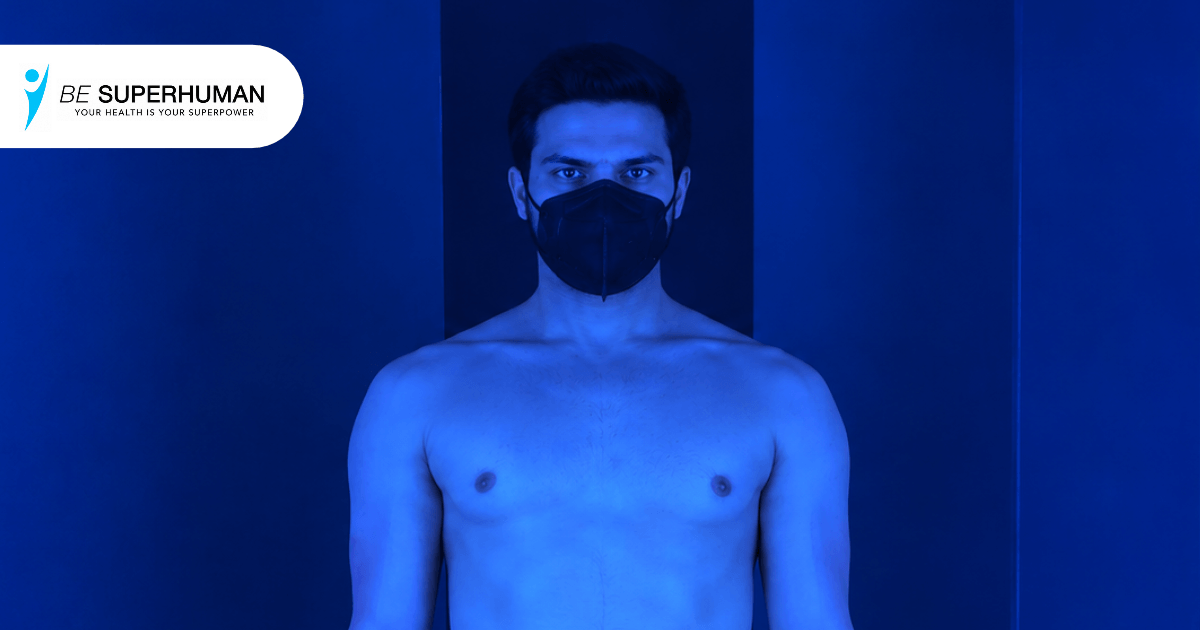
Red light at 660nm is still within the visible spectrum, which is why you see it as a glowing red colour when you’re under our panels.
Near-infrared light at 850nm sits just beyond what the human eye can detect, which is why it’s largely invisible even though you can feel a slightly deeper warmth from it.
Why Depth Is the Whole Point
Here’s the part that actually explains the two-wavelength approach, and it comes down to a fairly simple rule of physics: shorter wavelengths get absorbed sooner, and longer wavelengths travel further before they do.
Red light, being the shorter of the two, gets absorbed quickly by the outer layers of skin. It doesn’t travel far, but it doesn’t need to, because the structures it’s working on, the skin’s surface layers and the fibroblasts responsible for collagen production, sit right there near the surface.
Near-infrared light, being the longer wavelength, passes through those surface layers with less absorption and carries on into deeper tissue, reaching muscle, and to some extent joint structures, several centimetres down.
It’s not a stronger light in any dramatic sense, it’s simply a wavelength that skin and surface tissue are less effective at stopping, so it keeps going.
Put simply, red light does its work at the surface because that’s as far as it gets. Near-infrared light does its work deeper down because that’s how far it reaches before it’s absorbed.
What Each One Is Actually Doing Once It Gets There
Once either wavelength reaches its target depth, the underlying mechanism is broadly similar, it’s thought to be absorbed by mitochondria, the structures inside cells responsible for producing the energy those cells run on.
The theory, known as photobiomodulation, is that this absorption supports the mitochondria’s capacity to produce that energy slightly more efficiently.
So the mechanism doesn’t change between the two wavelengths.
What changes is which cells get exposed to it in the first place, purely because of how far each wavelength physically travels before it’s absorbed.
Red light supports the cells it reaches near the surface, skin cells and fibroblasts. Near-infrared light supports the cells it reaches further down, in muscle and connective tissue.
Why We Don’t Just Pick One
Given that explanation, it would be reasonable to ask why clinics don’t simply use whichever wavelength matches what someone’s trying to achieve, red light only for skin concerns, near-infrared only for muscle recovery.
The honest answer is that most people walking through our doors want more than one outcome from the same fifteen minutes, and the two wavelengths genuinely don’t compete with each other when delivered together.
Our full-body panels run both wavelengths simultaneously across your whole body.
Someone coming in mainly for post-exercise muscle ease is still getting the surface-level benefit on their skin at the same time, and someone coming in mainly for complexion is still getting a degree of support at the deeper tissue level, without needing to book two separate sessions or decide in advance which one matters more to them that day.
A Genuinely Simple Analogy
If it helps to picture it, think of red light as something that only needs to reach the front few rows of a concert, and near-infrared as something built to reach the back of the room.
Both are doing a job, they’re just not aiming at the same depth, which is exactly why running them together covers more ground than either one would alone.
Why This Matters More Than the Marketing Suggests
A lot of red light content online tends to flatten this into one vague claim, “red light therapy helps skin and recovery,” without explaining that it’s genuinely two distinct mechanisms working at two distinct depths, doing two distinct jobs.
Understanding the actual physics behind it is useful for a practical reason, it’s part of why a full-body panel delivering both wavelengths at once tends to offer more rounded value than a single-wavelength handheld device covering a small area with only one of the two.
It also explains why consistency tends to matter more than intensity with this particular therapy.
You’re not flooding tissue with light and hoping for a dramatic one-off effect, you’re giving surface and deeper cells repeated, manageable exposure to wavelengths they’re able to actually absorb and use, session after session.
The Bottom Line
Red light and near-infrared light aren’t two versions of the same thing, they’re two different tools that happen to come from the same panel, chosen specifically because of how differently they behave once they reach skin.
One stays shallow because that’s where it’s absorbed. One goes deeper because it isn’t.
Running both together during your session simply means you’re covering the full range of what this therapy can actually offer, rather than only half of it.
If you’re curious about the complete picture, including the other therapies this mechanism pairs well with, that’s exactly the kind of conversation worth having on your first visit.
Frequently Asked Questions
It doesn’t use two colours exactly, it uses two wavelengths, red at around 660nm and near-infrared at around 850nm. They’re chosen because they penetrate skin to different depths, allowing one session to support both surface-level skin cells and deeper muscle tissue at the same time.
No. Red light is visible and sits around 660nm, working mainly on the skin’s surface. Near-infrared light sits around 850nm, is largely invisible to the eye, and travels deeper into tissue, making it more relevant to muscle and recovery.
Its main advantage is depth. Because it’s absorbed less readily by surface tissue, it reaches further into muscle than red light does, which is why it’s generally associated with recovery and muscle ease rather than skin appearance.
It isn’t really a question of strength, it’s a question of depth. Each wavelength is suited to the tissue it actually reaches. Using only one would mean only addressing one depth of tissue, which is why BE SUPERHUMAN’s panels run both together.
Most people notice the visible red glow clearly, while the near-infrared light is felt more as a subtle, slightly deeper warmth rather than seen. Both are working throughout the same fifteen minutes.
Talk To Therapists
Schedule a call to talk to out health optimisation therapists at BE SUPERHUMAN
Latest Posts
- All Posts
- Active Recovery
- Cellular Health
- Everyday Energy
- Health Optimisation
- London Wellness
- Recovery Tech